The BMRC implemented a layer of protection against disruptive bot traffic. Learn more.
National Archives at Chicago - Notable Black History Records
September 3, 2026
The National Archives at Chicago, located at 7358 South Pulaski Road, is a local branch of The National Archives and Records Administration (NARA) which is tasked with being the record keeper for the United States. The Chicago Branch of NARA has been in its current location since 1973 and holds the permanent records created by federal agencies and courts in Illinois, Michigan, Indiana, Minnesota, Ohio and Wisconsin. Although NARA Chicago is not a member of the BMRC, it's important to recognize that it holds archival records that are vital to any telling of Black (Chicago) history in the 20th century.
"The National Archives at Chicago has more than 140,000 cubic feet of historical records dating from 1800 to the early 2000's, including textual records and non-textual records such as maps and photographs from Federal courts and some 85 Federal agencies"(NARA Chicago).
In this research note, we want to call attention to some of the records related to Black Chicago history. One of the most notable court cases whose records are housed at NARA Chicago are the Iberia Hampton, et al. v. City of Chicago, et al. . This case was heard in the US District Court in Chicago and the case file consists primarily of court testimony and depositions related to the suit Iberia Hampton, mother of Fred Hampton, brought against the City of Chicago as well as state and federal agencies and individuals for the murder of her son. The lawsuit was filed by Hampton's mother along with Fannie Mae Clark, the administratrix of Mark Clark's estate, and the others involved with the raid including Verlina Brewer, Deborah Johnson, Ronald Satchel, Harold Bell, Blair Anderson, Brenda Harris, and Louis Truelock.
NARA Chicago also holds the records of landmark housing and school discrimination cases involving African Americans. For example,
- Harvey Evans Clark, Jr, et al vs. Town of Cicero et al
- Heard in the US District Court in Chicago. Clark was a WWII Vet who moved from Mississippi to Cicero, IL with his wife and young children. Around 4,000 local townspeople burned the Clark's possessions on the lawn, and Harvey Clark was beaten by the local authorities and driven out of Cicero.
- West Chicago Suburban Branch Of The National Association For The Advancement of Colored People, et. al. vs. Edgar Elbert, et. al.
- Heard in the US District Court in Chicago. The West Chicago Suburban Branch Of The National Association For The Advancement of Colored People (NAACP), representing residents of Maywood, Illinois, brought a civil suit against the Mayor of Maywood at the time, Edgar Elbert, and other town leaders, for discrimination based on housing, recreation, and employment due to their race. The first case of action in the complaint involved the arrest of future Black Panther Fred Hampton.
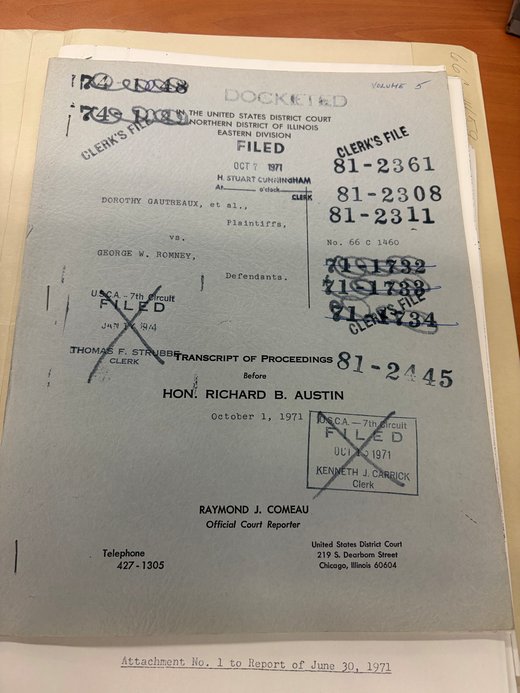
- Dorothy Gautreaux, Odell Jones, Doreatha R. Chrenchaw, Eva Rodgers, James Rodgers, and Robert M. Fairfax v. The Chicago Housing Authority, et al.
- Heard in the US District Court in Chicago. One of the first major public housing desegregation lawsuits. It charged that by concentrating more than 10,000 public housing units in isolated African American neighborhoods, the Chicago Housing Authority and the U.S. Department of Housing and Urban Development (HUD) had violated both the U.S. Constitution, which guarantees all citizens equal protection of the laws, and the 1964 Civil Rights Act, which outlaws racial discrimination in programs that receive federal funding.

- Julia Rogers v. Leroy Loether, et al.
- Heard in US District Court in Milwaukee. In 1969 plaintiff Julia Rogers was refused rental housing by the defendants, and subsequently filed a lawsuit alleging racial discrimination in US District Court. In 1970 the District Court ruled for the plaintiff, finding racial discrimination in violation of the Fair Housing Act of 1968. The case was appealed in 1971 and eventually went to the United States Supreme Court in 1973.
Some cases related to school segregation in Chicago and in neighboring Ohio and Indiana include:
- James H. Vines et al. v. James Cruse et al. and Eva V. Gazaway by John W. Gazaway, her next friend vs. William J. White
- Two school desegregation cases heard in the US Circuit Court in Cincinnati in the 1880s
- Anthony P. Burroughs, et al. v. Benjamin Willis, et al. v. the Board of Education of the City of Chicago and Benjamin C. Willis
- Heard in the US District Court in Chicago. This is a civil case in which eleven parents on behalf of their children brought a suit against the City of Chicago Board of Education and Benjamin Willis, general superintendent of the City of Chicago schools on January 19, 1962. The plaintiffs alleged that the defendants operating a segregated school system in violation of the Constitution. Judge Austin dismissed the case.
- Rachel Lynn Bell, a Minor, by Odessa K. Bell, Her Mother and Next Friend, et al. v. School City of Gary, Indiana
- Heard in the US District Court in Lafayette, IN. In this case, the parents of approximately one hundred children enrolled in Gary, Indiana public schools alleged that the defendant intentionally maintained a segregated school system in violation of their constitutional rights.
Other materials related to Black history held by NARA Chicago includes the records of Federal Judge James B. Parsons ( 1942-1993) of the US District Court for the Northern District of Illinois (Parsons was the first Black judge to serve on the U.S. District Court), and records related to Black freedom seekers who made it north.
The Fugitive Slave Acts of 1793 and 1850 gave enslavers a legal right to capture enslaved people who had escaped to free states and prosecute those that aided them. NARA Chicago hold records related to the Case files of Joshua Glover, a man who escaped enslavement in Missouri and lived in Wisconsin. Another significant case concerns the Crosswhite family, Francis Giltner vs. Charles T. Gorham from Michigan. These are just a few of dozens of identified Fugitive Slave Act of 1850 and 1793 case files. These cases hold invaluable information about the lives of formerly enslaved people and their struggles for freedom.
The Black Metropolis Research Consortium joins the voices of other concerned organizations in opposition to plans to close the National Archives at Chicago and send records related to Black Chicago history to storage facilities in other states around the country. We hope researchers will make use of these collections while they are still accessible.
.